|
Notes |
|
|
(0020194)
|
|
Ken Moreland
|
|
2010-04-15 14:33
|
|
|
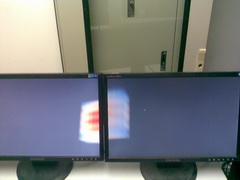
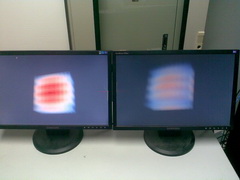
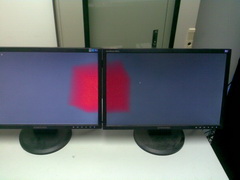
My guess is that the problem is with the representation proxy responsible for volume rendering image data. The problem appears to be independent of the image data volume renderer (see the attached images of the Wavelet rendering with two different mappers, both of which are broken). When you render, for example, an unstructured grid (such as in the attached image of box.ex2), it renders fine. |
|
|
|
(0020482)
|
|
Utkarsh Ayachit
|
|
2010-04-29 15:45
|
|
The problem is because the by default paraview does not use compositing on tile-displays for small data. We support movement of polydata/unstructured grid, so they are happily cloned on all tile machines and hence volume rendering works. But with image data, we don't move the data around and hence the volume rendering looks broken.
Setting "Compositing Threshold" to 0 under the Tile Display Parameters does the trick.
However this is a nuisance. As a fix, the tile display view should automatically detect if volume rendering is being used and force a compositing mode. |
|
|
|
(0037810)
|
|
Kitware Robot
|
|
2016-08-12 09:58
|
|
Resolving issue as `moved`.
This issue tracker is no longer used. Further discussion of this issue may take place in the current ParaView Issues page linked in the banner at the top of this page. |
|
 Wavelet-FixedPointMapper.jpg (17,669) 2010-04-15 14:31